15 Tasks A Virtual Legal Assistant Can Do For You

The demands of a legal practitioner can be overwhelming. As they try to stay on top of their game and win cases, lawyers also have to run their practice or oversee the various administrative duties in a law firm. The long hours, meetings, and deadlines combined with intense pressure can take a toll on a lawyer’s overall performance and mental well-being.
As a member of the legal field, it may seem that there simply isn’t enough time in your day to manage everything for your practice. That’s where a virtual legal assistant (legal VA) comes in.
If your practice has never explored virtual staffing, you may wonder what it is and what it can do for you. Let’s explore what a legal VA is and what they can do for your legal practice.
What is a virtual legal assistant?
A virtual legal assistant (VLA or legal VA) is a professional who provides administrative or personal assistant services. The VLA works remotely from anywhere in the world, usually as an independent contractor.
Compared to hiring full-time, in-house employees, outsourcing to a legal VA is the more cost-effective option. Since they support legal practices from their own remote office, they don’t require clients to invest in additional office equipment or supplies. Additionally, your
Lawyers or law firms hire legal VAs to handle the repetitive but essential tasks of a law office, including transcription, file management, legal research, email and call handling, and the like. As such, virtual legal assistants should have some basic knowledge about the legal profession.
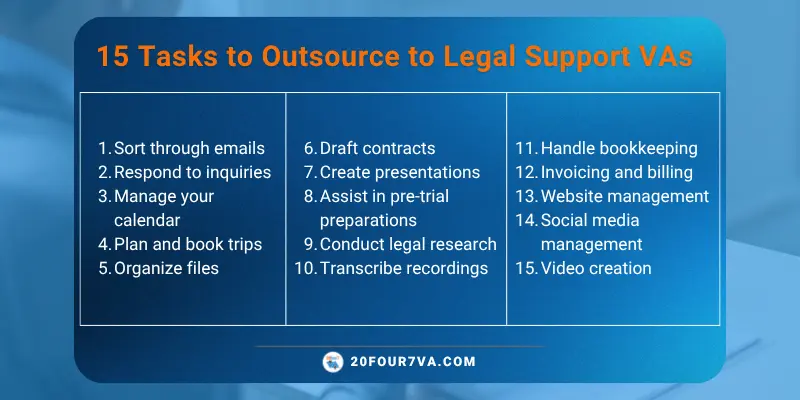
15 tasks to outsource to legal support VAs
According to this Brightpearl study, “The average worker spends 21 and a half hours doing admin work.” That’s almost two full days you could have used doing more important tasks.
To help you manage your workload and schedule, it’s time to outsource these fifteen essential but time-consuming tasks to your legal VA:
-
Sort through emails
Take a look at your unread emails. Chances are, there are lots of them. A VLA can help manage your inbox by going through your work emails and notifying you of important correspondence.
-
Respond to inquiries
As a lawyer, you’re always on your feet. You can’t spend all your time answering the phone or replying to messages. A legal VA will manage client communications, sorting through emails, drafting responses, and escalating priority messages as needed.
-
Manage your calendar
It will be your remote legal assistant’s duty to manage your calendar and keep you on track. The VLA will make sure you don’t miss meetings, appointments, and important deadlines by reminding you of your schedule. Having an organized calendar will also help the VLA keep track of your activities so they can make changes if necessary.
-
Plan and book trips
Lawyers travel a lot. Litigators, for example, may need to fly or hit the road to meet clients or witnesses. Other reasons for travel include attending trials, arbitrations, meetings, and other court procedures.
You can’t waste time booking flights and finding hotels to stay in. Your precious time is best spent doing research and studying for the case you’re handling. Your VA can handle travel management responsibilities, allowing you to focus on your cases without worrying about missing a flight.
-
Organize files
A VLA can be tasked with keeping all the files organized. Lawyers cannot afford to lose or misplace even one document. In a worst-case scenario, a lost document, such as a vital piece of evidence, may cost the lawyer the case.
The files should be accessible from any device so you can take a look whenever and wherever you are. The VLA should also show you the ins and outs of the filing system in case your assistant is unavailable.
-
Draft contracts
Verbal agreements can be easily disputed. A legally binding document in the form of a contract helps ensure that all agreements, responsibilities, and promises are clearly defined and protected.
A legal virtual assistant will help draft legal documents using the details you will provide. They should make sure that the contract can be clearly understood so that both parties will be comfortable signing it.
-
Create presentations
Law practitioners often rely on presentations to communicate their capabilities to prospective clients. Your chances of representing them may depend on how clear and impressive your presentation is. The legal VA may assist you by creating presentations that convey your message with less text and more graphs, figures, and other visuals.
-
Assist in pre-trial preparations
The legal VA will provide the lawyer with assistance in preparing for trials. They will be tasked with writing reports, drafting contracts, and other legal documents necessary in a case. The VLA may also be asked to procure documents that will be used as evidence, such as affidavits and formal statements.
-
Conduct legal research
Proper legal research is vital to a case, and while legal professionals gain that skill from law school and during practice, they can’t find everything they need all at once. A legal VA can assist the lawyer by doing some of the necessary research, which will demand hours out of your busy schedule at the firm.
-
Transcribe recordings
When you’re juggling multiple cases, it’s not realistic to rely on memory alone. Having accurate transcriptions of interviews, depositions, and other recordings will make it easier for you to review details and prepare case materials.
However, transcribing can demand a lot of your time. A 30-minute recording can take 2-3 hours to type and edit. Instead of doing it on your own, you can outsource transcription duties to virtual legal assistant services.
-
Handle bookkeeping
Bookkeeping requires accuracy and close attention to detail. Even a small mistake can lead to costly corrections and unnecessary rework. A skilled legal VA can help manage these tasks for your law firm, keeping financial records organized, up to date, and easier to track.
-
Invoicing and billing
When you’re busy handling legal cases, activities like computing billable work hours and invoicing clients can take a backseat. A legal VA can support your team by taking on these duties, so you can focus on your top-priority tasks.
-
Website management
A website is one tool that can help lawyers and law firms get noticed. A legal VA with website management skills ensures your site stays organized, user-friendly, and aligned with your firm’s branding and goals. Part of their task can also include producing SEO-driven content that will help the website rank high in searches, improving visibility and awareness among your target audience.
-
Social media management
Your law firm virtual assistant will be in charge of your digital marketing campaign, so they will also handle your social media accounts, such as Facebook, Twitter, and Instagram. The main objectives of these social media accounts are to improve your reach and engage with your target audience. The VLA will regularly post relevant content on these platforms that should be easy to read on both computers and phones. They will also increase social media engagement by interacting with users.
-
Video creation
YouTube is another popular platform that you can use to market your law firm. Take videos of yourself talking about different cases and legal tips. The legal VA will then edit the videos and make them more palatable to your audience. The VLA can also research topics that you can discuss and write the script for the video.
Get top-tier virtual legal support services with 20four7VA! Schedule a free consultation call with our team, and we’ll help you find the best VA for your firm.
What to look for in a virtual legal practice assistant
Technical writing
An online legal assistant can be tasked to draft contracts and other important documents. Obviously, a legal assistant needs to know how to compose error-free write-ups. One simple typographical error can be detrimental to a case. Mistakes in spelling, grammar, or sentence construction can cause misunderstanding. Aside from having proper writing skills, the VLA should also be thorough in reviewing all documents they write.
File, project, and schedule management
A productive workplace is one that is organized. There can only be progress in the office when everyone knows what they’re supposed to be doing and everything is where they’re supposed to be.
The ability to be organized is one of the most important skills to look for in a virtual employee. The VLA candidate should know how to build a file system that is easily accessible even by old school attorneys who can’t keep with technology. The VLA should also be an expert in organizing the work calendar so you don’t miss out on deadlines, meetings, events, and projects.
Technical research
A virtual assistant should be computer and internet-savvy. They work on their computer all day, so these skills are definite must-haves. A VLA candidate should know more than the basics of computer use. Some programs they should be familiar with include Microsoft Office, particularly Word, Excel, and PowerPoint. Familiarity with apps that can be used to improve productivity in your office is also a plus.
Research skills are necessary for the success of a case. The VLA should be able to locate expert witnesses who can give testimonies based on their specializations. A background check on your potential witness may also be necessary.
The VLA will also have to do some research related to the cases you are handling. This will include looking for legal documents and unearthing some facts about the case and those involved.
Research skills will also be necessary for marketing your services. The VLA should know how to look for trends and other marketing gems that can help get you more clients.
Transcription
As mentioned, a legal VA will likely be asked to transcribe recordings. It’s not enough to just play and listen to the recording. A VLA needs strong typing skills, meaning typing fast and accurately. They will also need to edit their work for errors, so editing skills are a must-have, too. Plus, the VLA should have a little background on lawyer lingo and legal processes.
Professional communication skills
Communication is vital in a remote work setting. The legal VA should be able to convey their messages and concerns to their employer clearly so that all tasks will be done without a hitch. At the same time, the VLA should know how to communicate properly with potential clients as they will be tasked with handling inquiries and follow-ups.
Positive attitude
Look for a VLA with a pleasing personality and a great attitude, particularly towards work. As a remote worker, a VLA should know how to prioritize and take their work seriously. They should also be motivated to perform well.
Flexibility
Many remote workers have multiple jobs, so they set a certain time to focus on each one. One advantage of this is that they will try to accomplish as much as they can during your work hours. However, you may want your VLA to be flexible. There will be times when you need to have something done immediately, so it will be advantageous for you if your VLA is available when you need it.
Trustworthiness
As a lawyer, you’re dealing with sensitive information. If any piece of vital information is leaked out, you may lose a case. You will also lose potential clients if people find out that your office cannot be trusted.
You need to look for a remote legal assistant who values confidentiality. In fact, it should be one of the core principles of every remote employee and freelancer. Since there is no physical interaction between an employer and a virtual legal assistant, the latter should do what they can to prove that they can be trusted. If they break that trust, potential employers will think twice before obtaining their virtual legal assistant services.
Need help screening applications and finding the best-fit VA for your law practice? Book a free consultation with the 20four7VA team to get end-to-end remote staffing services.
Common concerns about hiring a virtual legal assistant
While more and more organizations turn to virtual assistant staffing, it’s natural to still have questions or reservations about bringing a legal VA on board. Below are some of the most frequently raised concerns about hiring a VA, along with practical ways to address them.
“I don’t know what a virtual legal assistant is.”
One of the most common reasons why lawyers are wary of hiring a virtual legal assistant is that they don’t know what a virtual legal assistant actually is. Many lawyers who have been at it for years or even decades are quite hesitant to adapt to current trends, including those related to the practice. Since many old-timers are not that keen on technology, they may not be aware of virtual assistants. Some may even dismiss the fact that remote workers are necessary in this day and age.
Solo practitioners and lawyers of small local law firms may also not see the need to hire virtual legal assistant services. However, you’ve spent years studying law, not accounting, information technology, or secretarial jobs. A virtual legal assistant will take such tasks not directly related to your practice off your hands.
“What if my virtual legal assistant suddenly quits?”
In any kind of business, it’s always difficult if even one employee suddenly calls in sick. Most of the time, this can be remedied. The employer will have to make the necessary adjustments to compensate for the worker’s absence.
The problem multiplies tenfold if an employee suddenly quits or disappears completely without any notice. This is a legitimate concern for lawyers regarding virtual legal assistants.
It is the responsibility of virtual legal assistant companies to have VLAs in their stable that are ready to provide service anytime it is needed. But truth be told, it may be difficult for the lawyer to adjust to a new remote assistant, especially if they are currently handling a case.
One possible remedy to this potential problem is to hire a virtual legal assistant from a reputable company such as 20four7VA. A reputable VA company vets virtual assistants to ensure they have the right set of skills, relevant experience, and ability to adhere to ethical business practices.
“How do I know what my virtual assistant is working on?”
Another common concern of lawyers is that their virtual legal assistant doesn’t accomplish their tasks on time or at all. One way to avoid this is to stay in constant communication with each other. It can be as simple as sending messages or having calls to check on the status of certain tasks. However, most attorneys are too preoccupied to regularly check on their virtual legal assistant. The VLA should take it upon themselves to constantly send updates to their employer.
When assigning tasks, the lawyer should indicate the order of priority. The remote assistant can then work on the time-sensitive projects first before proceeding with other tasks. Again, effective communication is vital. If you have a task that suddenly needs to be prioritized, you should communicate this clearly to your virtual assistant.
Another solution is to use a time tracker or task management system. Such software allows the employer to see the status of a task designated to the virtual legal assistant. In instances that you cannot reach your virtual legal assistant, you can still check on a task by logging into the task management software.
“How do I trust someone I’m working with remotely?”
Since a lawyer’s job is complicated, it’s understandable why some are quite apprehensive when dealing with a virtual legal assistant. For one, they cannot physically see and interact with the person. Some lawyers may find it difficult to delegate and explain tasks to a computer screen.
Furthermore, some legal practitioners may have a difficult time trusting someone they cannot physically interact with. It’s true that one can get a better feel about a person after seeing them face-to-face. This is impossible with remote assistants.
Before hiring a VLA, you will have to interview the person. Make the most of this opportunity to know the applicant. Once the applicant is hired, keep the communication lines open so you can integrate the VLA more easily.
Get top-tier legal virtual assistant services with 20four7VA
Whether you’re a newbie lawyer or a veteran of many years, you need all the help you can get. Hiring a virtual legal assistant is one way to reduce workload and alleviate stress. Delegating these fifteen tasks is not just about saving hours. With the right VA, not only can you save valuable hours, you can optimize your resources while focusing on what matters most—serving clients and practicing law at a higher level.
Ready to manage your workload and elevate your practice? With 20four7VA, you gain access to highly skilled, pre-vetted legal virtual assistants who are trained to support law firms with accuracy, confidentiality, and efficiency. From routine tasks like appointment scheduling and document management to legal-specific duties such as legal research and client intake, we match you with the right VA so you can streamline operations and focus on winning cases and serving clients.
Book a free consultation today and discover how the right legal VA can help your firm operate smarter, faster, and more cost-effectively.