5 Ways a Real Estate Database Management VA Can Help You

If you’re a real estate professional, your database can be your best asset or worst liability. It’s either making you money or causing you to quietly lose it. For busy real estate agents, brokers, and property managers juggling hundreds or thousands of contacts across residential and commercial portfolios, keeping that database clean and actionable is a full-time job in itself.
That’s where a real estate database management virtual assistant (VA) comes in. Their role, however, goes beyond simply entering data into your CRM or other database systems.
A skilled real estate database management VA can help you turn scattered contact information into a reliable, organized resource that supports lead generation, follow-ups, client relationships, and long-term growth. By taking repetitive but important database tasks off your plate, they also give you more time to focus on activities that directly drive revenue.
Learn more about what these specialized VAs do, five concrete ways they can transform your real estate business, and best practices for working with one.
What is a real estate database management VA?
At its core, a database is a structured collection of data. A real estate database management VA is the person who makes that structure work for your real estate business every single day. This role sits at the intersection of virtual admin assistant, data analyst, and CRM coordinator, but with a deep knowledge of how real estate professionals actually use their systems.
Data collection in real estate includes gathering client contact information and property preferences, and the VA systematizes all of it. They build, maintain, and optimize your real estate database and CRM so that contact data, property details, and deal records stay accurate and usable.
They work inside commercial real estate databases, property management software, and sales CRMs, handling tasks like importing spreadsheets, normalizing fields, and connecting people to properties and deals. Think of them as a CRM data management virtual assistant trained specifically for real estate workflows.
Why a strong real estate database matters
Before diving into specific VA tasks, it’s worth understanding why your real estate database deserves dedicated attention in the first place.
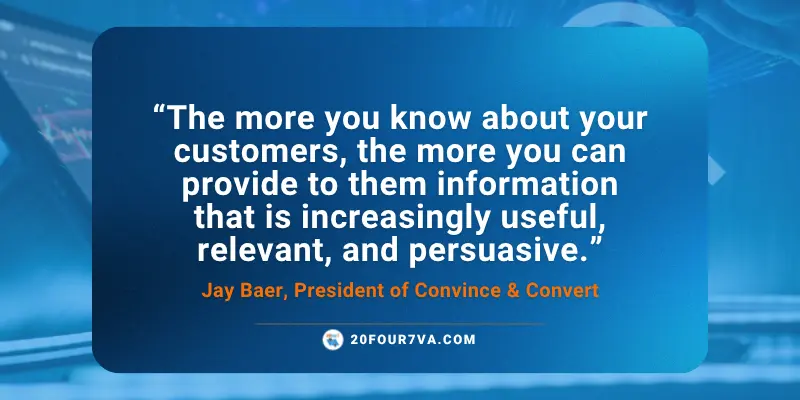
As Jay Baer, President of online customer service and digital marketing consultancy Convince & Convert, advises, “The more you know about your customers, the more you can provide to them information that is increasingly useful, relevant, and persuasive.” A strong real estate database supports your efforts to thoroughly understand your customers. It is the backbone for every contact, property, and transaction record in your real estate business-spanning active buyers, sellers, tenants, landlords, investors, and vendors. Real estate databases centralize data for easier access, and a centralized database enables scalability and better organization for growing businesses.
Consider the numbers: a solo agent might maintain 300–500 high-quality contacts. A small team handles 1,000–2,000 records. But bloated, unsegmented lists of a thousand or more contacts that haven’t been maintained rarely convert. Without regular upkeep, your pipeline fills with raw data that can’t drive informed decisions.
Clean, structured data connects directly to higher gross commission income. It enables timely follow-ups, targeted marketing campaigns, and accurate market analytics. Analyzing historical data within a database aids in decision-making and forecasting, whether you’re projecting next quarter’s closings or identifying which neighborhoods are heating up. Yet databases often require manual updates and lack advanced analytics on their own. That’s exactly the gap a specialized VA fills.
Improve your real estate database with the right real estate virtual assistant. Schedule a free consultation with 20four7VA to reap the benefits of virtual assistant staffing.
The impact of a real estate database management VA
Here are five specific ways a database management VA can transform how you run your real estate business.
#1 Cleaning and structuring your estate database
No automation or analytics works if the underlying data is messy. This is the VA’s first priority-typically tackled in month one.
The VA starts by auditing your existing estate database (spreadsheets, CRM, email marketing lists) for duplicates, incomplete records, and outdated contact data. Regular data cleaning ensures accurate records by removing duplicates and outdated information.
Specific cleanup tasks include:
- Merging duplicate people or companies
- Standardizing phone formats and state abbreviations
- Updating bounced emails and verifying addresses
- Removing or archiving inactive leads with no activity before a defined cutoff (e.g., last active before 2022)
There are systems that automate routine database management tasks, reducing human error, but only you and your VA can define the rules. The VA works with you to establish required fields (name, email, mobile, property preferences, lead source, status) and enforces those standards on every new record. They can also document a simple data dictionary (i.e., what each field means and how it should be used) so everyone on the team follows the same rules. This is what separates an organized database from a data graveyard.
#2 Managing contact data and segmentation
How many contacts you have matters far less than how many contacts are ready to act. This is where segmentation makes the difference.
Your VA classifies contacts into clear groups: sphere of influence, hot leads (0–90 days), nurture leads (3–12 months), past clients, tenants, landlords, and investors across residential and commercial real estate. Data organization involves segmenting contacts into categories such as buyers and sellers, and segmentation in databases involves grouping contacts for relevant targeting.
Inside your CRM software, the VA sets up tags or custom fields to capture details like property type (office, retail, multifamily), budget range, preferred neighborhoods, and lease expiration month for commercial tenants. They track property preferences so your outreach always hits the mark.
This segmentation powers targeted marketing efforts. Segmented lists allow for hyper-targeted marketing campaigns. Examples include sending Q4 market updates only to potential sellers or renewal reminders only to tenants with leases ending in the next six months. Tracking engagement metrics helps identify prospects that are interested and ready to engage, so your team can prioritize time with people who are most likely to transact.
#3 CRM software administration and automation
Your real estate CRM should be a living system, not an expensive address book. A VA makes sure it works as intended.
A VA can manage platforms like Follow Up Boss, Zoho CRM, Wise Agent, Pipedrive, Propertybase, or custom commercial real estate databases integrated with comprehensive tools like Reonomy or CoStar. (Not sure which CRM fits your needs? Check out this guide to the best CRM for real estate.)
Key administration tasks include:
- Configuring pipelines (buyer, seller, landlord, tenant, investor) with stages that mirror your actual selling process
- Ensuring every new contact and property is automatically assigned to a stage
- Setting up automation features: email drip campaigns for new leads, alerts when a contact revisits a listing page, task reminders for 30–60–90 day follow-ups, and triggers based on lead score or last contact date
Centralized CRM platforms eliminate the confusion of scattered contacts. CRMs manage client interactions and track purchase history and transaction history in one place. Automated maintenance logs emails, text messages, and phone calls automatically, giving your team a complete view of client communication without manual entry.
Workflow integration connects databases with marketing tools, social media tools, and transaction management software. Modern databanks integrate advanced technology and analytics, provide real-time insights, and streamline communication. These capabilities enhance decision-making processes for real estate teams.
#4 Lead management and deal management support
This is where database management connects directly to revenue. Lead generation tools and property sites generate volume; your VA makes sure nothing gets lost. They capture every new inquiry from website forms, portal leads (Zillow, LoopNet, Crexi), social media marketing channels, and referrals, and add them to your CRM within a determined SLA, typically within 2 hours during business days.
The VA keeps every lead moving through your pipeline by updating statuses, logging calls and emails, and flagging stalled deals for your personal attention. Lead scoring prioritizes leads based on engagement and intent, so you always know which contacts deserve a personal touch versus an automated sequence. Effective lead management improves conversion rates by 30%, and weekly pipeline reviews maintain accountability and oversight of sales stages.
On the deal management side, the VA attaches offers, LOIs, contracts, inspection reports, and closing documents to each record so nothing lives only in someone’s inbox. Transaction databases track deal details and communication information in a centralized system.
In commercial real estate, the VA tracks key dates like due diligence deadlines, lease commencement, rent escalation dates, and option periods-ensuring those are visible in your database and calendar.
#5 Property, listing, and market data management
Your real estate database isn’t only about people; it’s about properties too. A dedicated database management VA maintains a centralized inventory of active, pending, and closed property listings with fields for address, square footage, zoning, asking price, rent per square foot, photos, and media links. They keep property data up to date so management and marketing teams always see real-time information for marketing materials and listing presentations.
A commercial real estate database centralizes property data. It includes ownership information, transaction history, and market data. Commercial real estate databases improve data accuracy and support market analysis, helping teams verify ownership and track valuation data. A strong CRE database supports investment decisions and resource management, and these databases are used by brokers, investors, and property managers daily.
For market analytics, the VA logs comparable sales or leases, time-on-market, and price changes so you can pull actionable insights for investor reports. Analytics from databases inform strategic marketing decisions. For property management teams, the VA maintains rent rolls, vacancy lists, and renewal calendars-making the database a valuable asset for ongoing portfolio performance tracking.
How 20four7VA fits into your real estate data management strategy
20four7VA’s remote staffing model offers a scalable way to hire, manage, and retain real estate database management VAs without building an in-house admin team.
Our team recruits and vets candidates with experience in real estate CRMs, property management software, and commercial real estate databases, reducing ramp-up time significantly. Real estate databases improve operational efficiency significantly, and comprehensive databases enhance client relationship management-but only when someone skilled is maintaining them.
20four7VA handles HR, VA payment processing, time-tracking, IT support, and ongoing performance management, so real estate professionals can focus on growth rather than supervision overhead. Clients can start with a VA who works 10-20 hours per week for database clean-up. They can then increase their VA’s weekly hours or even hire multiple VAs as contact volume and property counts grow.
Book a free consultation with 20four7VA to review your current database, estimate workload, and get a tailored virtual assistant staffing solution.
Best practices when working with a real estate database management VA
Getting the most from your VA requires structure. Here’s how to make the collaboration productive from day one.
Set clear 90-day goals
Define concrete targets like “clean 3,000 existing contacts,” “migrate from spreadsheets to Zoho CRM,” or “tag all commercial real estate contacts by property type.” Vague instructions produce vague results.
Implement security measures
Data security and compliance are necessary to protect client financial and personal information. Use role-based permissions, share passwords via a secure tool like LastPass, and define read/write limits. Require NDAs for sensitive investor or financial data.
Run weekly check-ins
Have the VA report on key metrics: new contacts added, duplicates removed, marketing campaigns launched, deals updated, and engagement metrics. This establishes accountability and improves cohesiveness between your internal team VA.
Document SOPs
Write standard operating procedures for recurring tasks-how to enter a new listing, how to log a closed deal, how to archive dead leads. This makes work consistent and scalable, even if your VA changes.
Enhanced client relationships result from detailed notes on personal preferences and past interactions. Personalized communication boosts customer loyalty, so make sure your VA captures those details. The benefits of customer relationship management compound over time when your data foundation is solid.
Let 20four7VA find you the best-fit virtual assistant for real estate database management. Schedule a free consultation with 20four7VA today!
Frequently-asked questions (FAQs)
Can a VA handle both residential and commercial real estate databases? |
Yes. Many 20four7VA virtual assistants are trained to work across residential CRMs and commercial real estate databases, tagging contacts by asset class (office, retail, industrial, multifamily) and managing different workflows for each. The key is clear onboarding on your property type categories, field requirements, and the specific real estate database software you use. |
How do I measure whether my database management VA is delivering ROI? |
Track metrics like reduction in duplicate records, percentage of contacts with complete fields, campaign open and reply rates, number of leads followed up within 24 hours, and closed deals originating from database-driven campaigns. These valuable insights tell you whether the VA is turning your database into a revenue engine or just maintaining the status quo. |
How can I get 20four7VA virtual assistant services? |
Getting started with 20four7VA is simple and tailored to fit your unique real estate database management needs. First, you can book a free consultation through the 20four7VA website, where you’ll discuss your current database challenges, software platforms, and desired outcomes with an expert. This initial conversation helps determine the scope of work and the ideal VA skill set for your business.
Once your needs are assessed and the job description is approved, 20four7VA matches you with pre-vetted virtual assistants who have relevant experience in real estate industry database management, CRM administration, and lead nurturing. You can interview candidates to ensure the right fit in terms of expertise, communication style, and availability. After selecting your VA, 20four7VA handles all administrative tasks, including onboarding, payment processing, time tracking, and IT support, so you can focus on managing your business rather than managing staff. |